The Complete Guide to DICOM & NIfTI Annotation for Medical AI: Techniques, Challenges & Best Practices
- Abhijit P
- Aug 1, 2025
- 4 min read
Updated: Dec 12, 2025
Medical AI relies on high quality labeled datasets to detect tumors, measure organs, analyze scans, and support clinical decision systems.
This blog explains everything you need to know about DICOM and NIfTI annotation the gold-standard formats for MRI, CT, and other radiological imaging. You’ll learn how annotation works, why it’s essential, the challenges involved, and how accurate labeling directly impacts clinical AI performance.
Table of Contents
1 - What Are DICOM & NIfTI ?
2 - Why DICOM & NIfTI Annotation Matters for Medical AI ?
A. Tumor Detection & Diagnosis
B. Organ Segmentation
C. Abnormality Classification
D. 3D Volume Reconstruction
E. Clinical Decision Support
3 - Understanding DICOM & NIfTI File Structures ?
A. DICOM Headers & Metadata
B. Slice-Based Imaging
C. NIfTI Voxels & 3D Volumes
D. Orientation, Resolution & Coordinate Mapping
4 - How DICOM & NIfTI Annotation Is Done ?
A. Dataset Loading & Preparation
B. Slice-by-Slice Annotation
C. Volumetric Segmentation
D. Measurement & ROI Tagging
E. Metadata Structuring
F. QA & Clinical Validation
5 - Core Challenges in Medical Image Annotation ?
A. High Clinical Complexity
B. Dataset Size & Storage Requirements
C. Class Imbalance
D. Inter-Reader Variability
E. Multi-Modality Alignment
6 - Best Practices for Accurate Medical Annotation ?
A. Clear Protocols & Taxonomies
B. Clinical Expert Oversight
C. Multi-Layer QA
D. Tooling & Automation
7 - Final Thoughts
8 - Frequently Asked Questions
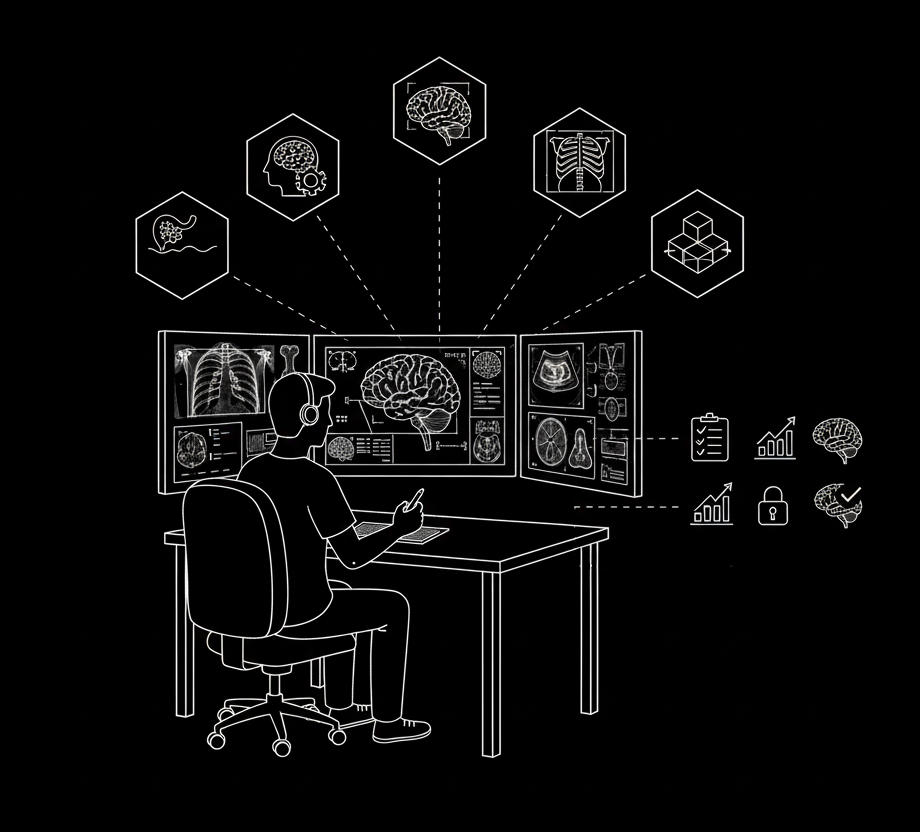
1. What Are DICOM & NIfTI?
DICOM (Digital Imaging and Communications in Medicine) is the global medical imaging standard for CT, MRI, ultrasound, PET, and X-ray. It contains both the pixel data and detailed metadata like patient ID, modality type, slice thickness, orientation, and acquisition parameters.
NIfTI (Neuroimaging Informatics Technology Initiative) is widely used in brain imaging, especially MRI, fMRI, and volumetric neuroimaging. NIfTI files store entire 3D volumes (or 4D fMRI time series) in a single file, making them extremely efficient for deep learning workflows.
Annotation of these formats involves precise marking of anatomical structures, identifying abnormalities, and segmenting organs or lesions across 2D slices and 3D volumes.
2. Why DICOM & NIfTI Annotation Matters for Medical AI
Medical imaging AI models rely on properly annotated data to:
A. Tumor Detection & Diagnosis
Tumors, nodules, lesions, hemorrhages, and abnormalities must be labeled with extreme precision to help AI models detect them early and accurately.
B. Organ & Anatomy Segmentation
Segmentation of brain regions, lungs, kidneys, heart chambers, vessels, bones, and tissues provides training data for anatomical AI.
C. Abnormality Classification
Identifying:
Inflammation
Fractures
Mass densities
Edema
Clots
Degenerative changes
helps AI models classify clinical conditions.
D. 3D Volume Reconstruction
Volumetric data from CT/MRI enables 3D organ structure modeling, tumor tracking, and surgical planning AI.
E. Clinical Decision Support
Annotated scans help AI systems support radiologists by improving:
Diagnostic accuracy
Scan triage
Treatment planning
Progress monitoring
3. Understanding DICOM & NIfTI File Structures
A. DICOM Headers & Metadata
DICOM embeds patient data, acquisition settings, scanner parameters, timestamps, and slice attributes. Annotators must preserve metadata integrity.
B. Slice-Based Imaging
Most DICOM studies contain 100–800+ slices, each requiring consistent labeling.
C. NIfTI Voxels & 3D Volumes
NIfTI organizes data into 3D voxel grids — far more suitable for deep learning models.
D. Orientation & Coordinate Mapping
Radiology images include:
Coronal
Axial
Sagittal
Proper alignment is essential for accurate 3D annotation.
4. How DICOM & NIfTI Annotation Is Done
A. Dataset Loading & Preparation
Includes:
DICOM extraction
NIfTI loading
Metadata parsing
Intensity normalization
De-identification for HIPAA compliance
B. Slice-by-Slice Annotation
Annotators label each image slice independently or via interpolation tools for efficiency.
C. Volumetric Segmentation
3D segmentation assigns voxel-level labels for organs, tumors, and abnormalities.
D. ROI Identification & Measurement
Includes:
Exact boundaries
Length
Volume
Density
Shape
E. Metadata Structuring
Metadata is standardized to support clinical model training.
F. QA & Clinical Validation
Involves:
Inter-radiologist agreement checks
Consistency audits
Gold-standard sampling
Bias control
5. Core Challenges in Medical Image Annotation
A. High Clinical Complexity
Medical scans require domain knowledge — errors can mislead AI models.
B. Dataset Size & Storage
A single CT study can exceed 300 images; 3D MRI scans are even heavier.
C. Class Imbalance
Diseases may appear only in a small number of slices.
D. Inter-Reader Variability
Different radiologists may mark abnormalities differently.
E. Multi-Modality Alignment
MRI, CT, and PET must sometimes be aligned and annotated together.
6. Best Practices for Accurate Medical Annotation
A. Clear Labeling Protocols
Standardized definitions for anatomy, lesions, and boundaries.
B. Clinical Expert Oversight
Radiologists or medical professionals guide the labeling process.
C. Multi-Layer QA
Combines automation and expert validation.
D. Advanced Tooling & Automation
AI-assisted pre-annotation improves consistency and reduces workload.
7. Final Thoughts
DICOM and NIfTI annotation are foundational to the future of diagnostic AI.As radiology AI expands, the demand for accurate, clinically validated datasets grows.Healthcare innovators need partners who understand both technical AI workflows and clinical precision — and who can deliver at scale.
8. Frequently Asked Questions
01 - What tools are used for DICOM/NIfTI annotation?
3D Slicer, ITK-SNAP, MITK, Labelbox, V7, MONAI Label, and custom medical platforms.
2. How do you ensure HIPAA compliance?
Through de-identification, restricted access, encrypted environments, and audit logging.
3. What formats do you deliver?
NIfTI, DICOM RT, JSON, masks, STL files, and custom clinical schemas.
4. Why is clinical QA important?
Medical AI requires extremely high precision due to patient safety.
Comments